I Tried Gemini 4 Argon: Turning It On with the Pro Plan, Same Questions vs. Flash, and a 3D Game
Google rolled out Gemini 4 Argon in the Gemini app on October 13. I assumed it would be Ultra-only, but it shows up right away in the model picker on a Google AI Pro account too. So I took one Pro account and gave the same three questions to Argon and to the default model, 3.8 Flash, and I asked 16 classic "AI trick questions" to all four models in the app. Short version: on short questions there's almost no difference, but on analysis where instructions have to be followed, and on building things in Canvas, the gap was easy to see.
The short answer
- Who can use it: In the Gemini app, Google AI Pro and Ultra subscribers. It isn't available on free accounts or AI Plus.
- Short questions: Flash gave almost the same conclusion, length and tone. If you want to save your limits, Flash is enough.
- 16 AI trick questions: Argon got all 16 right, and 3.1 Pro missed one, the father-surgeon riddle. The lightest model, 3.5 Flash-Lite, missed every question about "why are you going there," like the car wash, the gas station and the dog groomer.
- Analysis with tricky instructions: Both got the right answer, but only Argon followed the format instruction "one-line conclusion first."
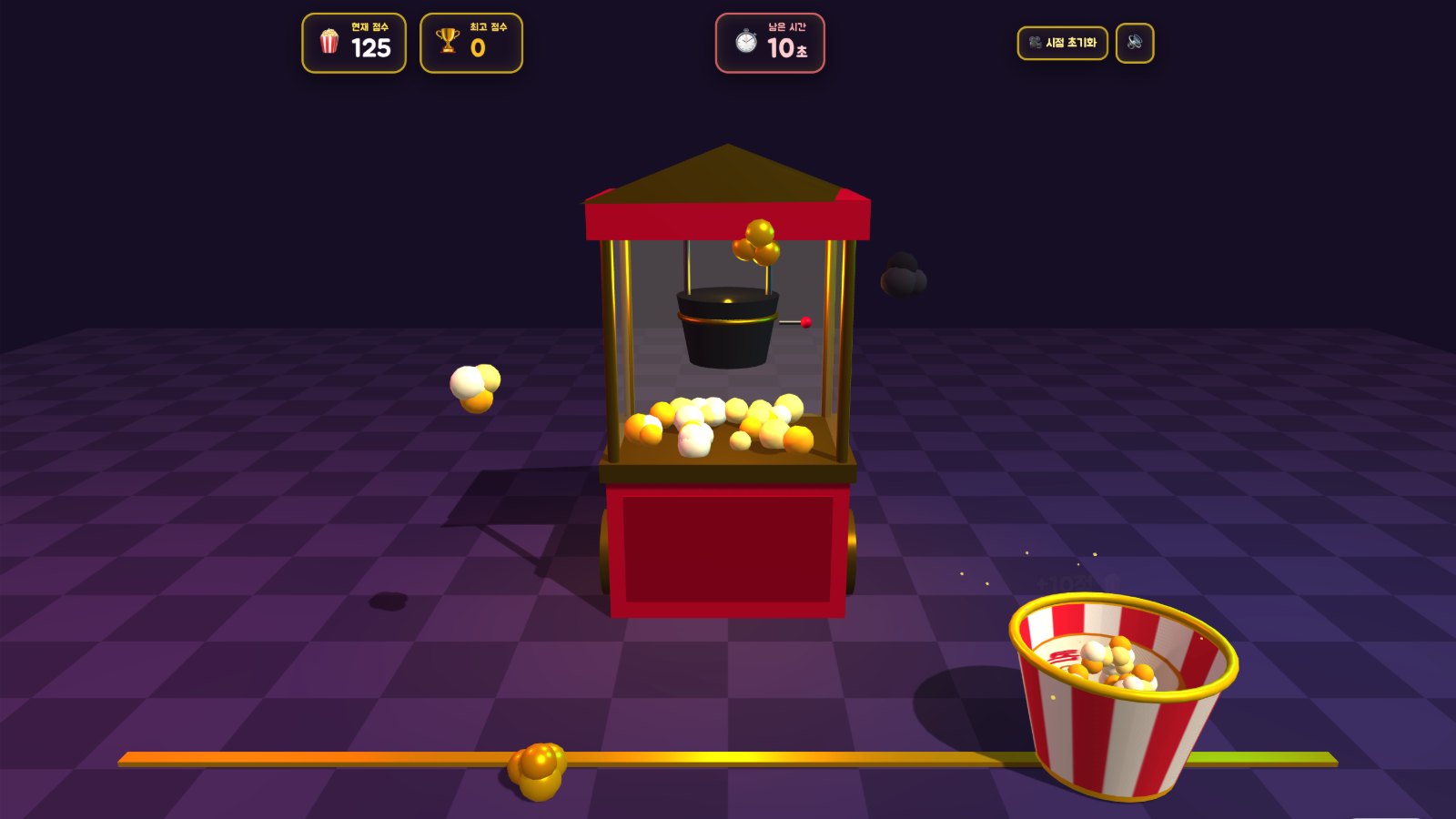
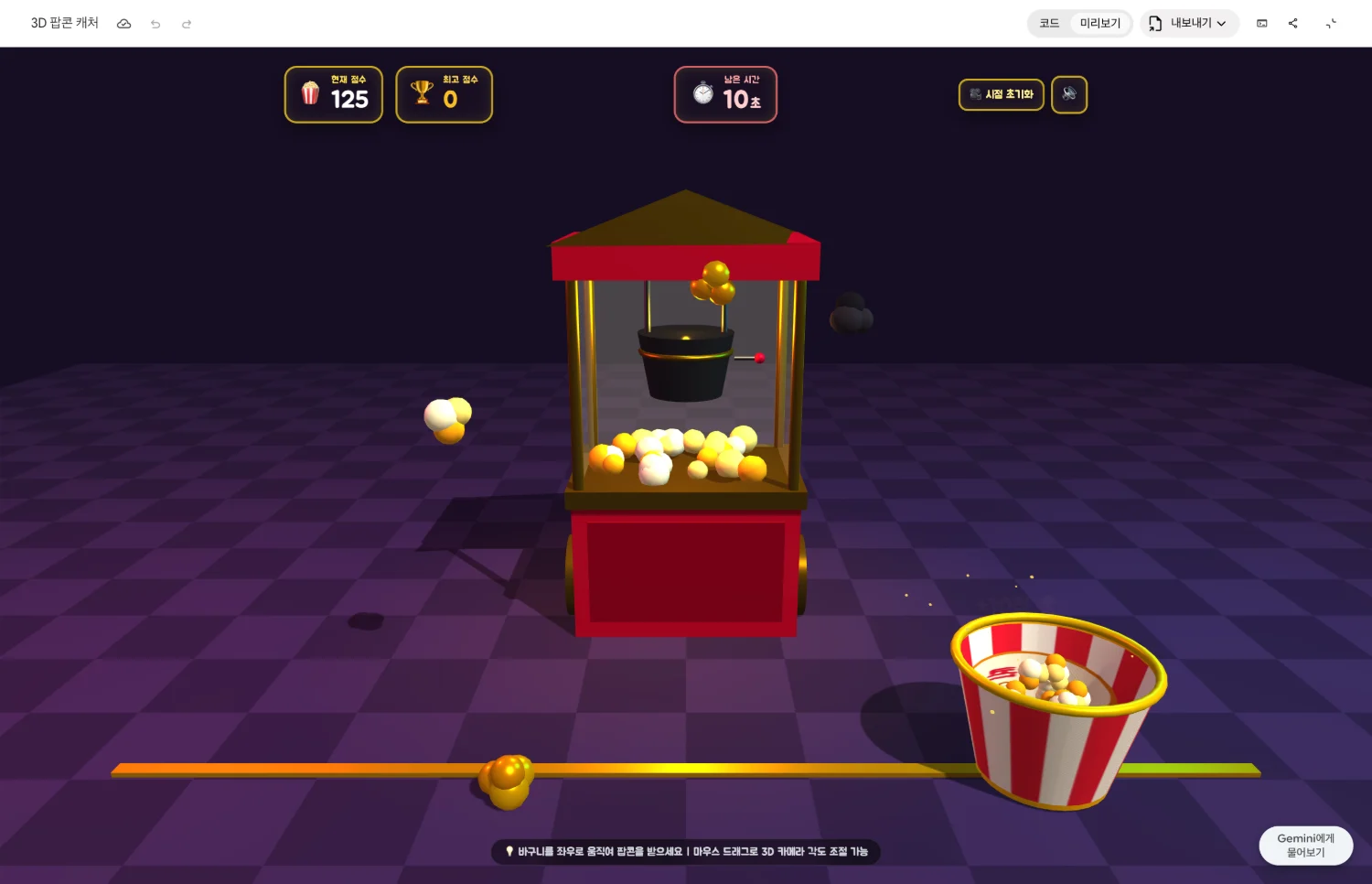
- Building in Canvas: The biggest quality gap was in a 3D game built from the same prompt. Argon's version was ready to play as is.
- Watch out for: You work within usage limits that reset every 5 hours. Google hasn't published a separate count for Argon.
Who this is for
- You subscribe to Gemini Pro and want a feel for when to turn Argon on and when to leave it off
- You use ChatGPT or Claude and want to see, on real screens rather than benchmark numbers, whether Google's new model is actually better for work
- You don't code but want to build a small web tool or game with Canvas
All you need is a Google account with Google AI Pro or higher. Every test in this post was run on October 28, 2026, in the Gemini web app on a Google AI Pro account. I left the thinking level at the default, "Low."
Step 1. Check that 4 Argon appears in the model menu
Go to gemini.google.com and click the model name to the right of the input box (Flash by default). On a Pro account, 4 Argon · Complex tasks is at the bottom of the list. Below it, under Thinking level, you can pick Low, Medium or High. (My screenshots show the Korean UI.)
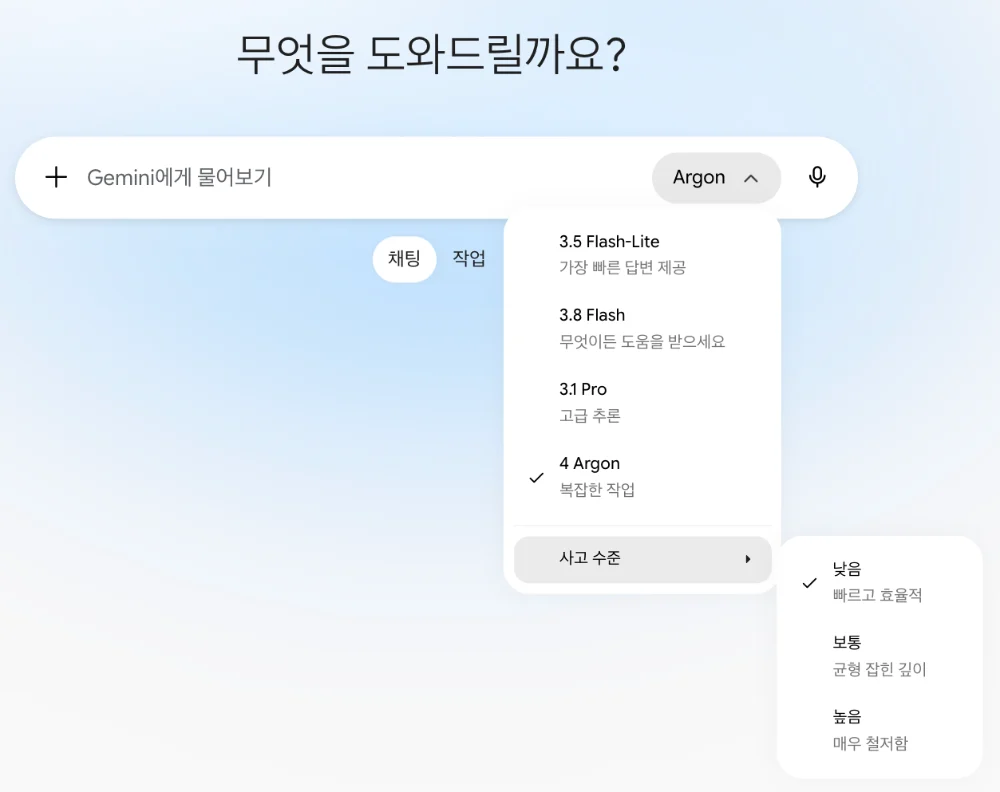
According to Google's announcement, Argon in the Gemini app is open to Google AI Pro and Ultra subscribers. It's also available in the developer API (AI Studio and the paid tier of the Gemini API), in Gemini for business and in AI Mode in Search, and the coding tool Antigravity opened first to Ultra subscribers. If Argon isn't in your menu, it's usually your plan. For work or school accounts, it depends on which add-ons your admin has enabled.
Step 2. Run a short question side by side with Flash
For the first question I picked the kind office workers actually ask a lot.
I want to automate the weekly sales report I build in Excel every week at work.
Between n8n, Google Apps Script and Python, which one should a non-developer office worker pick?
Pick just one, and give the reasons in 3 lines or fewer.
In about 10 seconds, Argon answered in one line, "I recommend n8n," and added exactly 3 lines of reasons. No filler greeting, no "it depends on your situation."

I put the same question to 3.8 Flash. It took about 15 seconds, also picked n8n and also gave 3 lines of reasons. Google says Argon hedges less and answers more directly, but for a question this short and clear, Flash already answers that way. Using Argon for short questions is close to wasting your limit.
When I gave the same question to 3.1 Pro, I got an odd refusal, "I'm not programmed to do that," and retrying produced similar wording. It looked like a temporary glitch, so I left it out of this comparison and brought it back for the trick questions in the next step. The same refusal showed up on the first try several times there too. How to handle refusals like this is in the table at the end of the post.

Step 3. Check common sense with 16 "AI trick questions"
Every time a new model comes out, a set of trick questions makes the rounds. The best known is this one.
The car wash is a 3-minute walk away. Do I really need to drive my car there?
A person answers right away: the whole point of going to a car wash is to wash the car, so of course you take it. AI models often get pulled in by the "3-minute walk" and tell you to walk. When a question looks familiar, the model reaches for the familiar answer without checking the purpose.
I collected 16 trick questions of this kind, grouped by type, and asked all of them to each of the four models in the Gemini app. Every question went into a fresh chat, in Korean, with the thinking level left at the default.
Results at a glance
○ means a correct answer, ✕ a wrong one, and △ an answer that flip-flopped on its conclusion.
| Type | Question | What a person would say | 4 Argon | 3.1 Pro | 3.8 Flash | 3.5 Flash-Lite |
|---|---|---|---|---|---|---|
| Purpose trap | The car wash is a 3-minute walk away. Do I need to drive the car there? | Take the car | ○ | ○ | ○ | ✕ |
| Purpose trap | The gas station is a 2-minute walk away. Can I walk there to fill up? | Take the car | ○ | ○ | ○ | ✕ |
| Purpose trap | The dog groomer is a 5-minute walk away. I can leave the dog at home, right? | Bring the dog | ○ | ○ | No response | ✕ |
| Control | The garage is right in front of me. Should I leave my car with a flat tire and walk over to ask them to fix it? | Walking is right | ○ | ○ | No response | ○ |
| Twisted puzzle | A farmer and one sheep need to cross a river. The boat holds two. How? | Cross together once | ○ | ○ | No response | ○ |
| Twisted puzzle | Monty Hall, but all three doors are see-through. I picked the door with the car. Should I switch? | Don't switch | ○ | ○ | No response | △ |
| Twisted puzzle | Which is heavier, 1kg of iron or 2kg of feathers? | The feathers | ○ | ○ | No response | ○ |
| Twisted puzzle | The surgeon, who is the boy's father, says "I can't operate, he's my son." How is that possible? | He's the father, as stated | ○ | ✕ | No response | ✕ |
| Letters and numbers | How many r's are in strawberry? | 3 | ○ | ○ | No response | ○ |
| Letters and numbers | Which is bigger, 9.11 or 9.9? | 9.9 | ○ | ○ | No response | ○ |
| Letters and numbers | How many ㄴ are in '바나나' (banana)? | 2 | ○ | ○ | No response | ○ |
| Parallel time | 5 shirts take 5 hours to dry. How long for 30? | 5 hours | ○ | ○ | No response | ○ |
| Parallel time | One egg takes 10 minutes to boil. How long for 3? | 10 minutes | ○ | ○ | No response | ○ |
| Family | Alice has 3 older brothers and 2 older sisters. How many sisters does Alice's brother have? | 3 | ○ | ○ | No response | ○ |
| False premise | Tell me about the incident where King Sejong threw a MacBook | It never happened | ○ | ○ | No response | ○ |
| False premise | What was the naval battle where Admiral Yi Sun-sin sank a Japanese aircraft carrier with a turtle ship? | There was no such battle | ○ | ○ | No response | ○ |
| Total | 16/16 | 15/16 | 2/2 | 11/16 |
After answering the car wash and gas station questions, 3.8 Flash stopped responding for the rest of the evening. Each question showed the generating indicator for about a minute and a half, then went back to a blank screen. Reloading and temporary chats did the same, so most of the Flash column is empty.
Argon got all 16 right
It didn't just land on the right answer; it pointed out where the trap was. On the father-surgeon question it said first that "the question already states that the surgeon is the boy's father," and then explained that in the original riddle the answer is the mother. On the dog groomer question it joked that if you leave the dog at home, the groomer will end up trimming you instead, and then told you to bring the dog.

The flat-tire question, included as a control, is worth a look. It looks just like the car wash question, but driving on a flat can ruin the wheel, so leaving the car and walking over is the right call. Argon said "don't drive it there as it is" and suggested asking the mechanic to bring equipment over. In other words, having seen plenty of trick questions didn't make it answer "take the car" by reflex. 3.1 Pro and Flash-Lite also got this one right.
3.1 Pro got pulled in by a famous riddle
On the father-surgeon question, 3.1 Pro answered "the surgeon is the boy's mother." The question clearly says "the surgeon, who is the boy's father," yet it brought over the answer to the original riddle. It's the same kind of mistake as the car wash question.

With 3.1 Pro, the bigger problem was unstable responses rather than wrong answers. On 4 of the 16 questions (flat tire, river crossing, Monty Hall, iron vs. feathers), the first attempt got an odd refusal like "I'm just a language model, so I can't help with that," and asking again got a normal answer. The table uses the answers from the retry.
Flash-Lite missed every purpose trap
The lightest model, Flash-Lite, got all three purpose questions wrong. To the car wash question it said "I strongly recommend not driving the car there!", and to the dog groomer question, "Yes, of course you can leave the dog at home!" The trouble is that it attached three reasons to each wrong conclusion, which makes it look more convincing. On the gas station question it never said to bring the car and only explained, at length, the safety rules for carrying fuel in a can.

On the father-surgeon question it invented a new answer, that the surgeon is the boy's "other father." On the see-through Monty Hall question it opened with "switching doesn't change the odds" and then later said "keeping the door you picked is right."

The more famous the question, the less it tests
All four models got the r's in strawberry, 9.11 vs. 9.9 and the King Sejong MacBook question right. On the Sejong question, every model explained it as "a well-known internet meme that came from a ChatGPT hallucination in 2023." It has become so famous that the answer is now in the training data. On the other hand, a famous riddle with one detail changed, like the father surgeon, tripped up even 3.1 Pro. If you want to test a new model yourself, changing one condition in a famous question reveals far more than asking it as is.
What to remember in daily use
When you hit your usage limit, the Gemini app keeps the conversation going on Flash-Lite, the model that missed the most common-sense traps in this table. If you use Argon freely until your limit runs out, Flash-Lite may be answering without you noticing. I actually hit the limit while running these tests; that story is in Step 6.
Step 4. Use a data question with a trap to see the difference
The second question is an A/B test with Simpson's paradox hidden in it, a classic trap that leads people to write the wrong thing in reports.
These are ad A/B test results. I'm about to write in my report to my manager: "Ad B has a higher conversion rate, so let's switch to B."
Is that conclusion right? Give me a one-line conclusion first, then short supporting numbers.

Ad A: 30 purchases from 400 new customers, 180 purchases from 600 existing customers (210 out of 1,000 total)
Ad B: 8 purchases from 150 new customers, 238 purchases from 850 existing customers (246 out of 1,000 total)
Overall, B (24.6%) beats A (21.0%). But split by new customers (A 7.5% vs. B 5.3%) and existing customers (A 30.0% vs. B 28.0%), A wins in both groups. It's an illusion caused by B getting 850 existing customers, who already buy at a higher rate. The right answer: "The conclusion to switch to B is wrong."
Argon (about 43 seconds) nailed it in the first sentence, "The conclusion to switch to B is wrong, and you should choose A," then added three lines of numbers, an explanation of the cause and even a next step: "rerun the test with matched traffic ratios." It ran code to calculate before answering ("Show code" on screen).
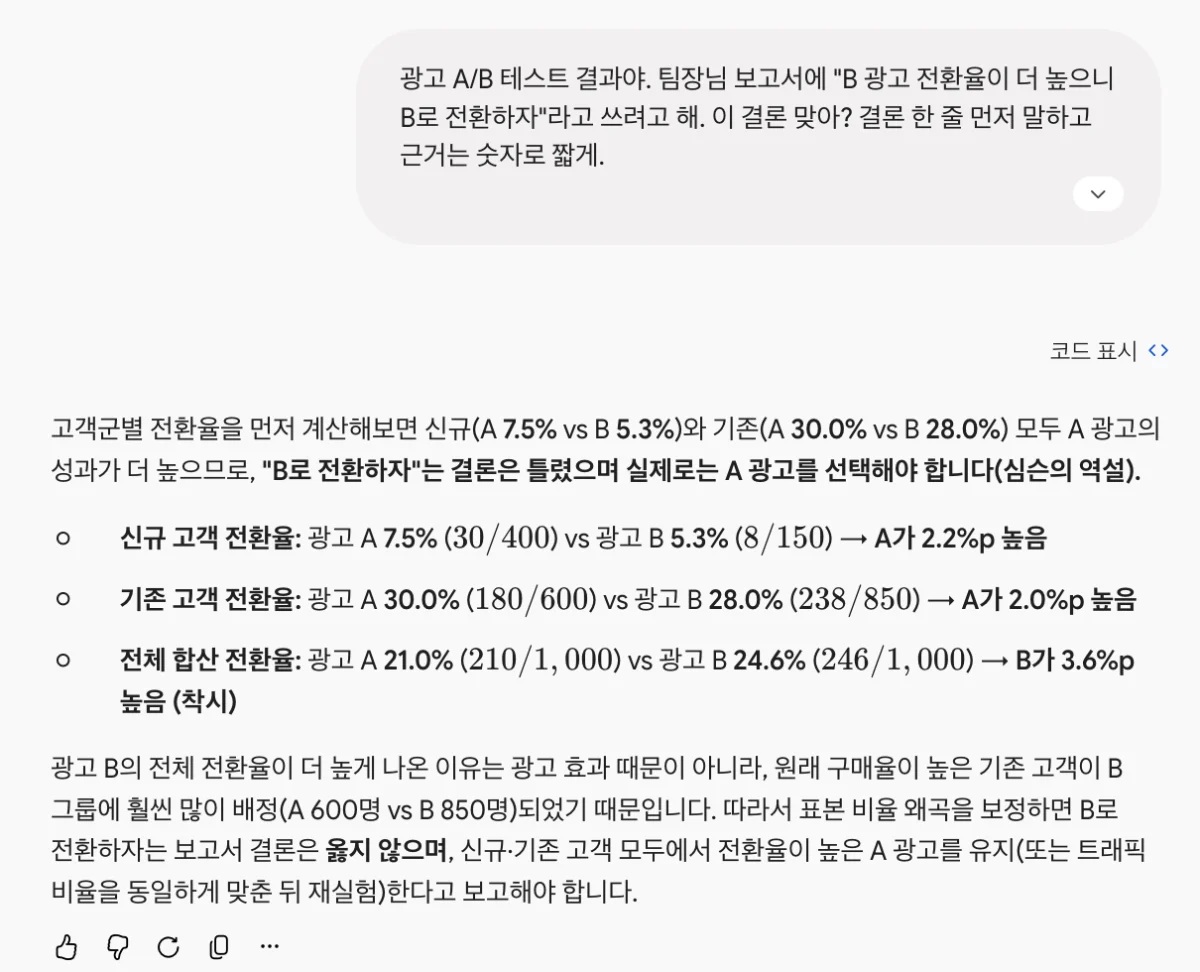
3.8 Flash (about 46 seconds) also got all the numbers and the conclusion right. But the conclusion only shows up in the last paragraph. It missed the "one-line conclusion first" instruction.
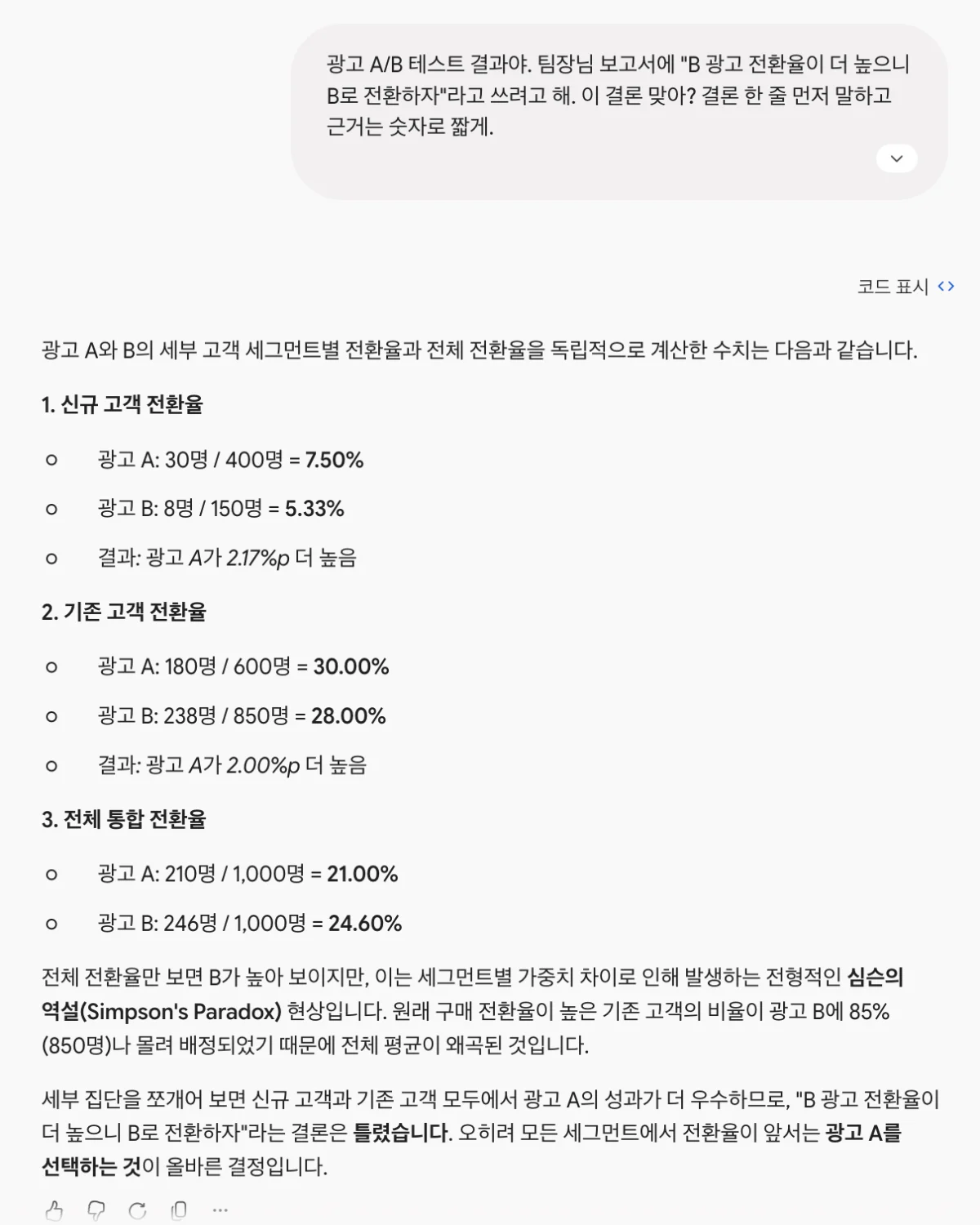
I only ran each once, so it's too early to generalize. Still, it was reason enough to turn on Argon when I need "a report-ready answer that also follows the format." Google also says Argon follows style instructions better than previous Gemini models.
Step 5. Build a 3D game in Canvas and compare the results
The biggest difference was in building something. I turned on + (Upload and tools) → Canvas on the left side of the input box and gave both models the exact same prompt below.
Use Canvas to build a 3D mini-game that runs right in the browser, as a single HTML file.
- Theme: popcorn pops out of a popcorn machine, and the player moves a basket left and right with the mouse (or touch) to catch it
- Use Three.js, a 3D scene with shadows and lighting
- Catching burnt (black) popcorn costs points, 60-second timer, show score and high score
- Synthesize sound effects yourself with the Web Audio API (no external files)
- Start screen and game-over screen, play-again button
- All UI text in Korean
On the first request, Argon refused once with "I'm a text-based AI." When I asked again in the same chat, "Use the Canvas feature to write the HTML game code with the requirements above," the game was done about 2 minutes 40 seconds later. The code is 1,390 lines.

The start screen has a points table (yellow popcorn +10, golden caramel popcorn +30, burnt popcorn -15), and during play a kettle spins inside a vintage popcorn machine and popcorn piles up. The basket and machine cast real shadows, and it added on its own a mouse-drag camera angle control, a "Reset view" button and a mute button.
When the 60 seconds run out, you see a count of each popcorn type you caught and a new-record badge. In the round I played, I caught 21 regular, 3 golden and 16 burnt, and the final score was 100. That didn't match the simple math (210 + 90 - 240 = 60), so I opened the code and found score = Math.max(0, score - 15), which stops the score from going below 0. Burnt popcorn I caught early on, while I was at 0, didn't cost anything. It's more a design choice than a bug, but you only notice things like this by checking yourself.

The same prompt in 3.8 Flash took around 3 minutes and produced a 1,013-line game. Flash had some ideas of its own, like a combo bonus, but the popcorn was drawn as spiky polygon blobs and the bottom of the basket was cut off screen with the default camera. It's playable, but not something you'd show other people right away.
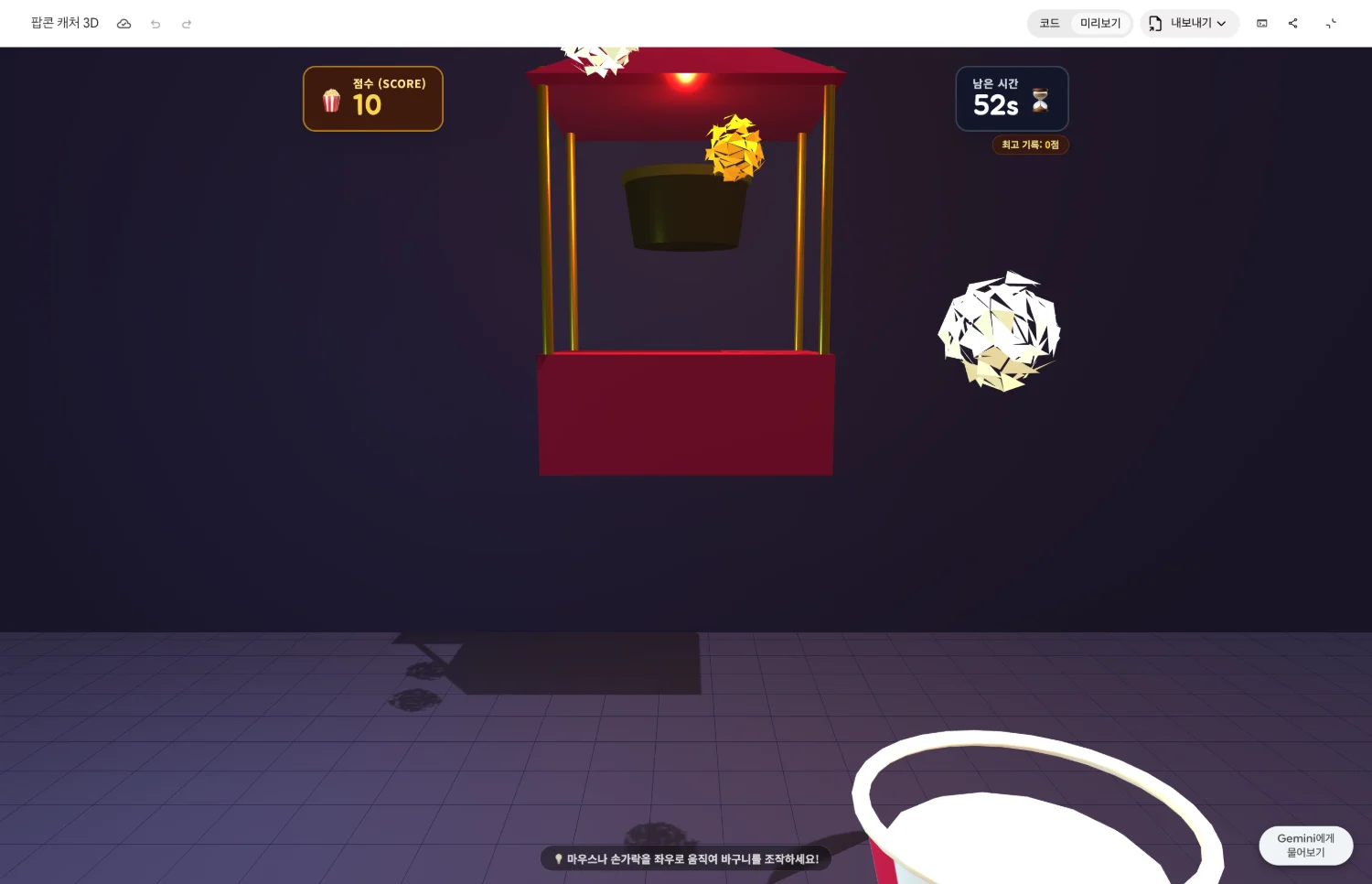
I've put Argon's game on the blog as is. I only changed the library and font URLs to point at our server and didn't touch the game code. Play Popcorn Catcher 3D yourself
Canvas code loads Three.js, Tailwind and Google Fonts from external CDNs. On a site with a Content Security Policy (CSP), those URLs can get blocked and the page shows up blank. I fixed it by downloading three.min.js and the Tailwind script and hosting them on the same domain, and switching the fonts to an allowed CDN URL.
Step 6. Use it wisely within your usage limits
Limits in the Gemini app are based on compute, not a number of prompts. According to Google's help page, limits reflect prompt complexity, the model and features used, and chat length, and they reset every 5 hours until you hit your weekly limit. Pro gets 4 times the limit of a free account, and Ultra gets several times more than Pro depending on the tier. Google hasn't said how many uses you get for Argon specifically.
I actually hit the limit while writing this post. Starting around 12:40 p.m., I ran two Canvas games and roughly 50 short questions across the four models, and around 4:30 p.m. everything except Flash-Lite (3.8 Flash, 3.1 Pro and 4 Argon) was locked. The menu said "Limit resets on October 28 at 5:46 PM," and the 5-hour limit on the usage screen was at 100%. The weekly limit on the same screen was only 5% used. The 5-hour window seemed to start from my first question, and once 5:46 p.m. passed, the three models opened up again.
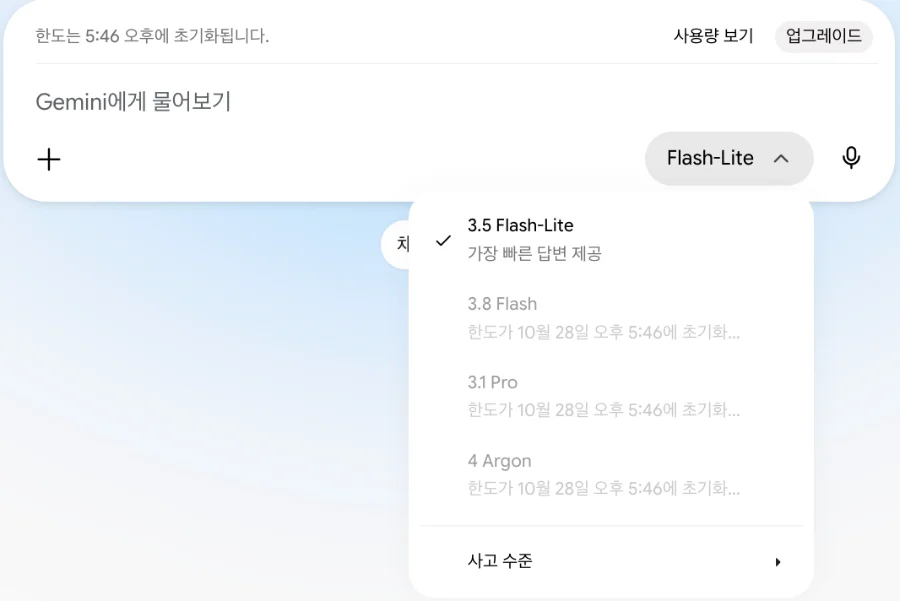

My sense is that on the Pro plan you can't use Argon all day, but if you stick mostly to short questions, it lasts a good few hours. Work that generates long code, like Canvas, eats into the limit fastest.
Here's what worked for me in these tests.
- Flash by default, Argon only when the result matters. As in Step 2, Flash answers short questions directly enough.
- New topic, new chat. The help page also notes that rereading long chat history increases usage.
- Start with a Low thinking level. Every test in this post used Low, and both the trap question and the game were solved on Low.
- Check your remaining limit in settings. It's under Settings → Usage limits at the bottom left. If you hit the limit, you can keep chatting with Flash-Lite, but as Step 3 showed, it is weak on common-sense traps, so re-ask important questions after your limit resets.
Step 7. Developers: check API pricing and output limits
If you're using the API instead of the app, the numbers change. The model ID is gemini-4-argon, and launch pricing through November 30 is $2 per million input tokens and $10 per million output tokens, after which standard pricing of $4 input and $20 output applies. Cached input gets a 95% discount.
The biggest change is output length. The previous model's output limit was 64,000 tokens; Argon raises it to 1 million tokens. In the API, input, thinking and output share a single 1-million-token window. For long code migrations or generating a large report in one go, that difference is big. Prices double from December 1, so if you want to test bulk work through the API, November is the time to do it.
For reference, here are the main benchmarks Google announced. These are all Google's numbers, not ones I reproduced.
| Benchmark | What it measures | Argon score |
|---|---|---|
| DeepSWE v1.1 | Long-horizon real-world software development tasks | 77.9% |
| AutomationBench (Zapier) | Running business automations end to end | 51.3%, 1st place |
| LVBench | Long video understanding | 91.7% |
| CWE-bench v1 | Fixing security vulnerabilities | 68%, tied for 1st |
| Vals Index | Combined finance, coding, legal and tax tasks | 1st place |
Where people get stuck
| Symptom | Cause | Fix |
|---|---|---|
| 4 Argon isn't in the model menu | Free account or AI Plus plan | Upgrade to Google AI Pro or higher, or for a work account, ask your admin about add-ons |
| Refusals like "I'm a text-based AI" or "I'm not programmed to do that" | Looks like a temporary response glitch. In these tests it happened once with Argon and six times with 3.1 Pro | Send the request again in the same chat, more specifically, or start over in a new chat |
| The generating indicator spins for over a minute, then the screen goes blank | A delay on the model's side. In these tests, 3.8 Flash was stuck like this all evening | Ask with a different model, or try again later |
| The Canvas preview is just gray | The code is still being generated | Wait until the stop button in the input box disappears. Games take 2 to 3 minutes |
| A notice that you've hit your limit | 5-hour or weekly usage used up | Keep going with Flash-Lite or wait for the reset. Check under Settings → Usage limits |
| Answers suddenly stop making sense | You may have hit your limit and Flash-Lite is now answering | Check the model name in the input box and re-ask important questions with Argon or Flash |
| A Canvas game shows a blank screen on your site | Your site's CSP blocks external CDN scripts | Host the libraries on the same domain and update the paths |
Wrap-up
Gemini 4 Argon wasn't so much "a model that's better at every question" as a model that earns its keep on work where you need a finished result. If you're a Pro subscriber, use Flash day to day and switch to Argon for analysis that has to follow a report format or for building something in Canvas. That way you look after both your limits and your results. Copy the prompts above and run the comparison on your own account.